
Every project with a database eventually runs into the same question: SQL or NoSQL? It’s one of the oldest debates in software, and it’s also one of the most frequently oversimplified, usually into some version of “SQL is for structured data, NoSQL is for everything else.” That’s not wrong exactly, but it hides most of what actually matters when you’re the one making the call.
This guide covers what each type of database actually is, the four shapes NoSQL databases come in, the trade-offs that genuinely separate them, and why in 2026 the honest answer is increasingly “it depends, and the line between them is blurrier than it used to be.”
What Is a SQL Database?
SQL databases are relational databases: data lives in tables with a predefined schema, and Structured Query Language is how you read and write it. That schema is also what gives SQL databases their biggest strength, ACID guarantees (atomicity, consistency, isolation, durability), which is why they’re still the default choice anywhere correctness under concurrent writes matters more than almost anything else, think financial transactions, inventory counts, anything with a ledger. PostgreSQL, MySQL, Microsoft SQL Server, and Oracle are the names you’ll run into most.
What Is a NoSQL Database?
NoSQL (“not only SQL”) databases skip the fixed relational schema in favor of formats that can change shape without a migration: documents, key-value pairs, wide columns, or graphs. That flexibility, plus an architecture built to scale horizontally across many servers rather than vertically on one bigger machine, is what makes NoSQL databases the common choice for large, fast-changing, or massively distributed workloads, think user-generated content, real-time personalization, or IoT telemetry arriving by the millions of events per second.
The Four Main Types of NoSQL Databases
“NoSQL” isn’t one data model, it’s an umbrella over four meaningfully different ones, and picking the right type matters more than picking NoSQL in the abstract.
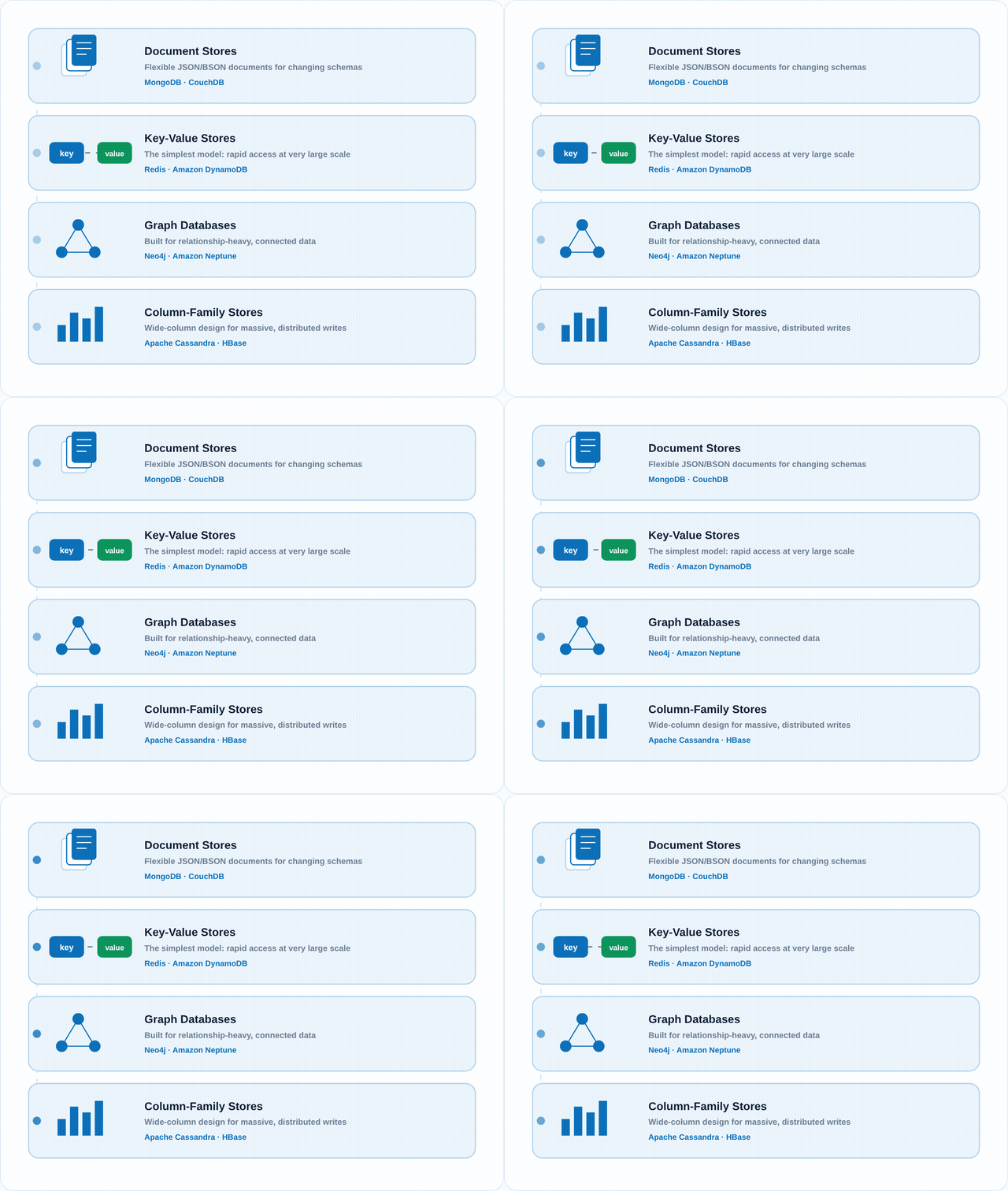
Document stores keep data as flexible, JSON-like documents, which makes them a natural fit for content that doesn’t share one rigid shape: product catalogs, CMS content, user profiles with optional fields. Key-value stores are the simplest model of all, pairing a unique key with a value and little else, which is exactly why they’re the fastest option for caching and session data at very large scale. Graph databases store relationships as first-class edges between nodes, which is what makes multi-hop questions like “friends of friends” or fraud rings fast instead of a chain of joins. Column-family stores organize data by column rather than row, built to absorb enormous, continuous write volume across many distributed servers, which is why they show up constantly behind time-series and IoT platforms.
SQL vs NoSQL: Weighing the Trade-offs
Neither side wins across the board, and the honest comparison runs along four axes that pull in different directions.
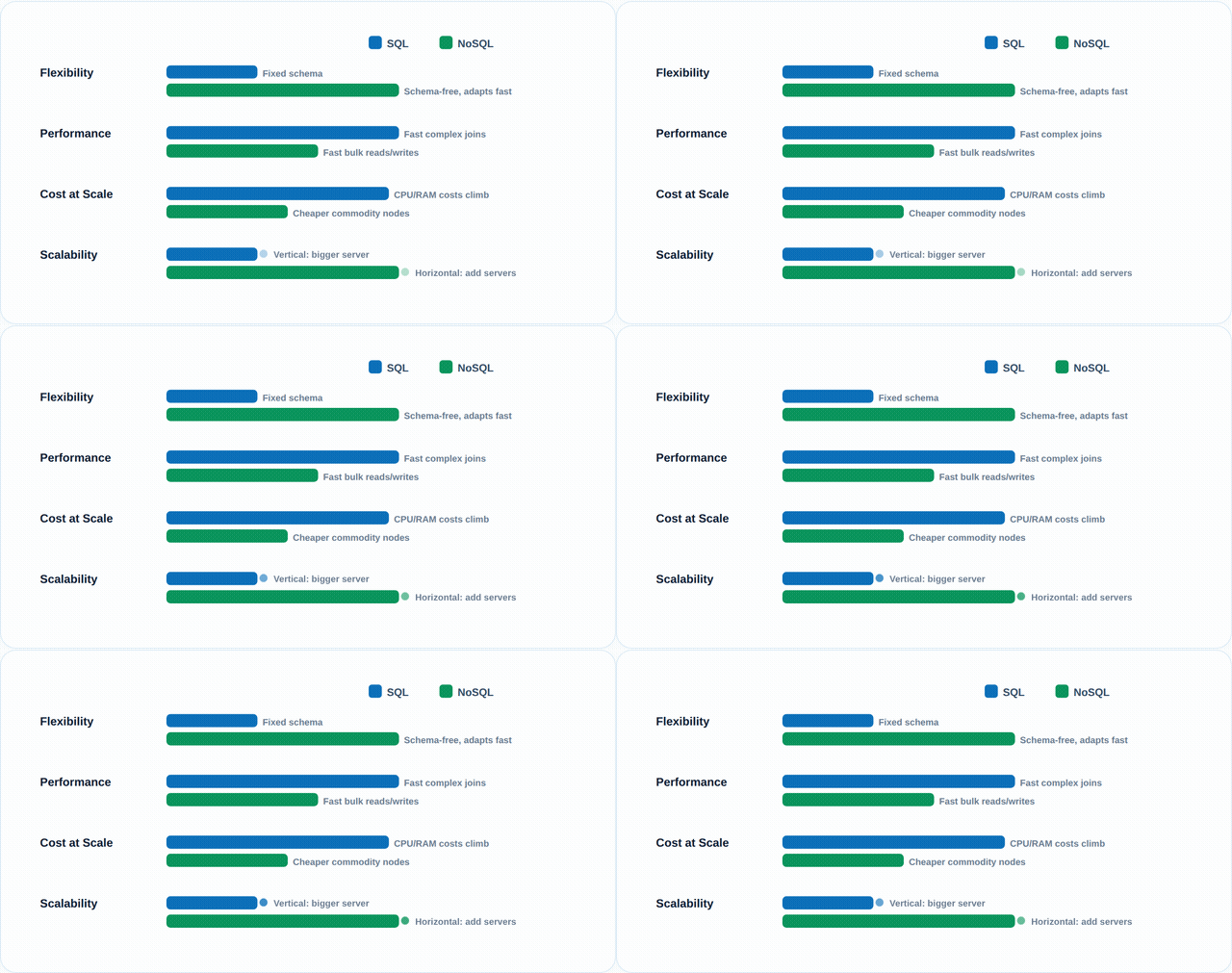
SQL databases hold you to a schema, which is exactly what makes complex, multi-table queries fast and reliable, but it also means a new category of data can mean a real migration. NoSQL databases let the data’s shape evolve without that ceremony, at the cost of the query-time guarantees a fixed schema buys you. On raw performance, SQL still tends to win when the question involves joining several tables together, while NoSQL tends to win on bulk reads, bulk writes, and real-time updates at high volume. Cost follows the scaling model: SQL databases scale vertically, so growth usually means a bigger, pricier machine, while NoSQL databases scale horizontally across cheaper, commodity servers, generally the more cost-efficient path once you’re operating at real scale.
Where This Fits in 2026: The Lines Are Blurring
A few years ago this would have been a cleaner either/or decision. It isn’t anymore, for three reasons worth knowing about before you pick a side.
First, PostgreSQL has quietly become a multi-model database in its own right. Between JSONB for flexible document-style storage, full-text search, PostGIS for geospatial data, and the pgvector extension for similarity search over AI embeddings (used in production by organizations including OpenAI), a single well-run Postgres instance now covers a lot of the ground that used to require a separate NoSQL system alongside it. For a vector workload under roughly ten million embeddings, pgvector is frequently the pragmatic choice precisely because it keeps your vectors in the same ACID-compliant database as the relational data they’re tied to, rather than syncing two systems.
Second, distributed SQL (sometimes called NewSQL) has eaten into one of NoSQL’s long-standing advantages. Systems like CockroachDB, YugabyteDB, and Google Spanner now offer horizontal scaling across many nodes while still speaking SQL and preserving ACID transactions, which used to be the exact trade-off you made by choosing NoSQL in the first place.
Third, recent developer survey data shows PostgreSQL’s usage share pulling well ahead of MongoDB’s, a reversal from the document-database enthusiasm of a few years back, as teams increasingly default to “start with Postgres and add what you need” rather than reaching for a separate specialized store up front. None of this makes dedicated NoSQL systems obsolete. Cassandra-scale write throughput, Neo4j-grade graph traversal, and Redis-grade latency are still genuinely hard to match inside a relational engine. But the decision now has a reasonable third option that didn’t used to exist: a single multi-model system, until your scale or your workload gives you a specific reason to split it out.
How to Actually Choose
Start from the shape of your hardest query, not the shape of your data. If the questions you’ll ask most often involve joining several related entities together and need transactional guarantees, start relational, and don’t rule out a distributed SQL engine if you already know you’ll need horizontal scale later. If your data is naturally document-shaped, relationship-heavy, or arriving at a volume that one bigger server can’t absorb, a purpose-built NoSQL system is still the more direct path. And if you’re already running Postgres and the new requirement is modest (a bit of JSON, a vector search feature, a geospatial lookup), check what your existing database can already do before standing up a second one.
The Takeaway
SQL and NoSQL were never really competing for the same job, they’re suited to different shapes of data and different scaling problems, and that hasn’t changed. What has changed by 2026 is the amount of overlap: a single Postgres instance can now reasonably cover relational, document, geospatial, and vector workloads at moderate scale, and distributed SQL has closed much of NoSQL’s horizontal-scaling advantage. The right call still comes down to your actual query patterns and your actual scale, just with more options on the table than this debate used to offer.
Join The Conversation
Share your perspective. Comments are moderated before they appear.