
In our last guide, we covered what data modeling is and the three levels every model passes through. This time we’re going one level deeper: the actual types of data models you’ll run into, from the ones that have been running production databases since the 1970s to the ones that exist specifically because of how AI applications store and search data today.
A genuinely comprehensive guide to this topic in 2026 can’t stop at the classic four, because plenty of the software you use daily isn’t built on any of them. So this one covers both eras: the models that still show up in architecture diagrams and textbooks, and the ones actually running most modern, large-scale, and AI-driven systems.
The Classic Models That Still Show Up in Architecture Diagrams
Relational. Data lives in tables, each with a defined set of columns, and relationships between tables are enforced through keys rather than direct pointers. Its biggest strengths are consistency and simplicity: normalization keeps redundant data out, and referential integrity keeps related records honest. Its biggest weakness is the flip side of that same rigidity, a schema change touches the whole structure, and queries across many deeply related tables can get expensive. This is still the default model for business applications, and MySQL, PostgreSQL, SQL Server, and Oracle are the systems built around it.
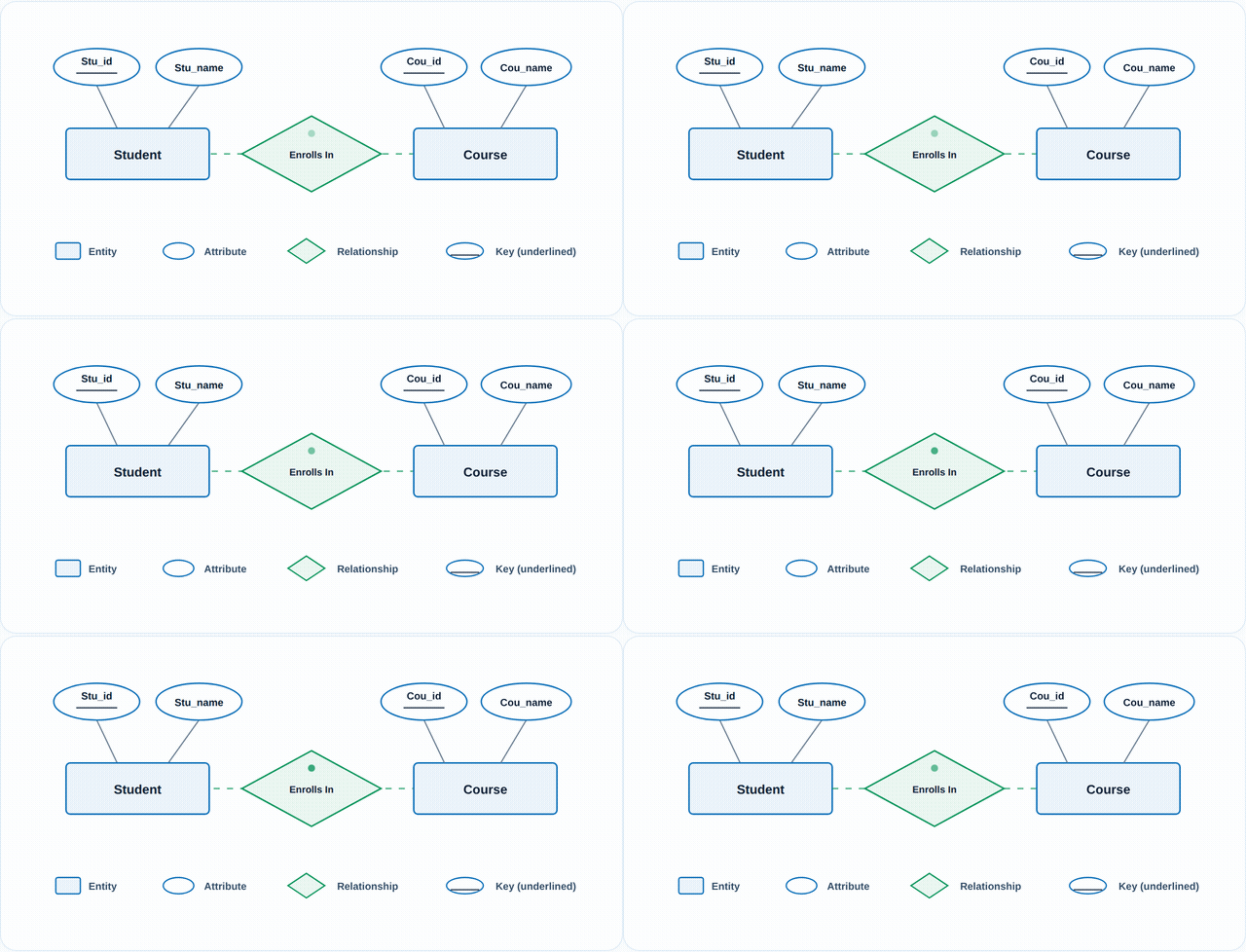
The Entity-Relationship Model. Here’s a distinction the original version of this guide blurred: the ER model isn’t a fourth database engine alongside the others, it’s a design notation used to plan a relational database before you build it. An entity (drawn as a rectangle) represents a real-world object like a Student or a Course, an attribute (an ellipse) describes a property of that entity, and a relationship (a diamond) describes how two entities connect, with key attributes underlined to show what uniquely identifies each entity. Sketch this out before writing a single CREATE TABLE statement, and the jump to an actual relational schema becomes mostly mechanical.
Hierarchical. Data is arranged as a tree: every record has exactly one parent, forming clean one-to-many relationships that are fast and simple to navigate. IBM’s IMS, which still runs inside plenty of banking and airline mainframes today, is built on this model. Its ceiling is structural: it genuinely cannot represent a many-to-many relationship (a course with multiple prerequisites that are themselves required by multiple other courses) without workarounds, and it offers little in the way of modern security controls.
Network. Designed specifically to fix that one-parent limitation, the network model lets a child record (a “member”) belong to more than one parent (an “owner”), which made it noticeably more flexible than hierarchical for its era. The CODASYL standard it’s based on saw real adoption and still turns up in some OSI and telecom systems, but it’s also more complex to query and was ultimately overtaken by the relational model’s simpler mental model for most new development.
The Models Running Most Software in 2026
None of the four classic models were built with internet-scale, semi-structured, or AI-driven data in mind, and three newer categories have picked up that work.
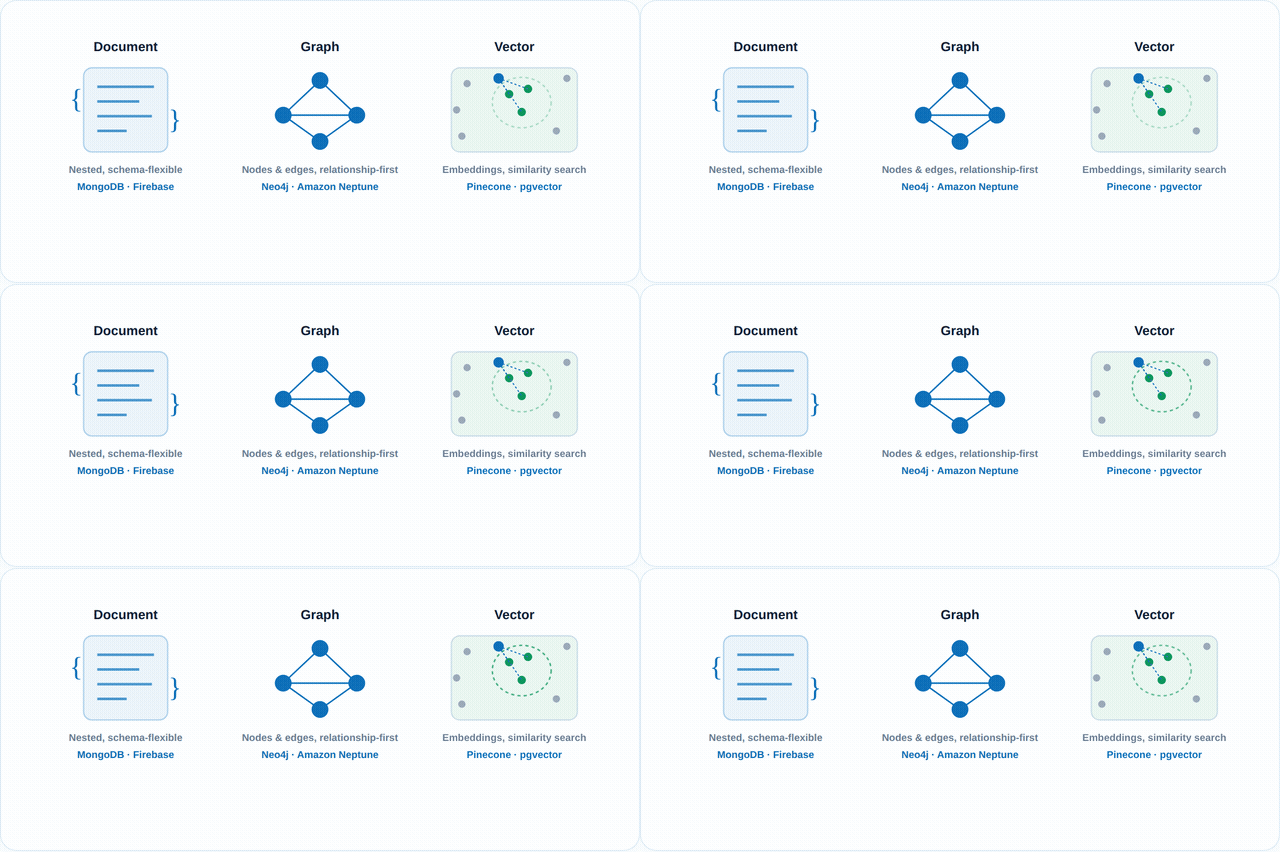
The document model stores records as flexible, nested JSON-like structures instead of fixed rows, which makes it a natural fit for data whose shape genuinely varies from record to record. We cover this in more depth, alongside key-value, graph, and column-family databases, in our SQL vs NoSQL guide. The graph model flips the relational approach on its head by making relationships themselves first-class, stored as edges rather than inferred through foreign keys, which is why it’s the right fit for fraud rings, social graphs, and recommendation logic; we go deep on exactly how this works, including SQL Server’s own built-in graph tables, in this guide.
The newest entrant is the vector (embedding) model, and it exists for a reason the classic models were never designed to solve: finding things that are conceptually similar rather than exactly matching. A vector database stores data as high-dimensional numerical embeddings and answers queries with approximate nearest neighbor search instead of exact lookups, which is what powers semantic search, recommendation engines, and retrieval-augmented generation (RAG), where an AI model’s response gets grounded in documents retrieved by meaning rather than keyword. Pinecone, Weaviate, and PostgreSQL’s own pgvector extension are the names you’ll see most.
How to Tell Which One You’re Actually Looking At
A quick gut check, when you’re staring at an unfamiliar system: if the data lives in fixed tables and you write SQL, it’s relational. If every record has a single clear parent and almost no exceptions, that’s hierarchical. If a record can reasonably belong to more than one “parent” category at once, that’s closer to network or, in a modern system, graph. If the records are nested, variable-shaped objects that don’t share one rigid structure, that’s document. And if what you’re querying is “find me things similar to this one” rather than “find me things that exactly match this value,” you’re looking at a vector model, whether or not the system calls itself a database at all.
The Takeaway
The four classic data models haven’t disappeared, relational especially is still the backbone of most business systems, but they were never a complete picture even when this guide first covered them, and by 2026 that gap has only widened. Document, graph, and vector models now carry a huge share of the data that modern and AI-driven applications actually run on. Knowing all seven, and more importantly knowing which shape of problem each one is actually built for, is what separates picking a data model on purpose from inheriting whatever a previous project happened to choose.
Join The Conversation
Share your perspective. Comments are moderated before they appear.